


Vanity of Vanities...All is Vanity: Words of the Preacher

Jan 25
5 min read
October 23, 2025 (updated 12/9/25 & 1/21/26)
By: Faith A. Gold
Listen while you read!
ECCLESIASTES
(Companion Bible Version)
"Vanity of vanities," saith the Preacher, "vanity of vanities; all is vanity." (Ecclesiastes 1:2).

One of my favorite books in the Old Testament is the Book of "Ecclesiastes," or also called "The Preacher." The book discusses and illustrates how corrupted our world has become and how enamored and obsessed people are with material possessions, materialism - things that don't matter at all - nor bring any love or true meaning to our lives...
The word Ecclesiastes has been used to refer to a preacher, speaker, or one who addresses an assembly of people. It is said that King Solomon was the writer of this book, but who really knows…The Hebrew name for this book is "Qoheleth" or "Koheleth" which comes from the Hebrew word "KAHAL," meaning "to call," "assemble," or "gather together."
My understanding of this "vanity of vanities" phrase, and main theme within Ecclesiastes, is that most people have become totally lost, chasing this false, self-created illusion of reality that isn't real. They have lost their true connection and understanding of their purpose and have clung to a fanstasy reality, sold to them by elite corruptors and deceivers of the world. People now only seem to care about material wealth and items and money...all things that do not depart with us once we are no longer here...
"Vanity of vanities," could also be interpreted as to say: "Meaningless...all is meaningless." Ultimately, it seems this phrase is conveying the message that vanity = separation from creator or source...being separated from the true divine and lost in an illusion of a meaningless existence...
Also, the author goes on in lament -- that there is no longer a love of wisdom nor a search for wisdom.
Defining Vanity
ORIGIN OF THE WORD "VANITY"
The book of Ecclesiates begins: "Vanity of vanities…all is vanity..."
The original word used for "vanity" was the Hebrew word, "HABEL" - which means "vapor" or "breath…." Also to describe something that will soon vanish....(see below);
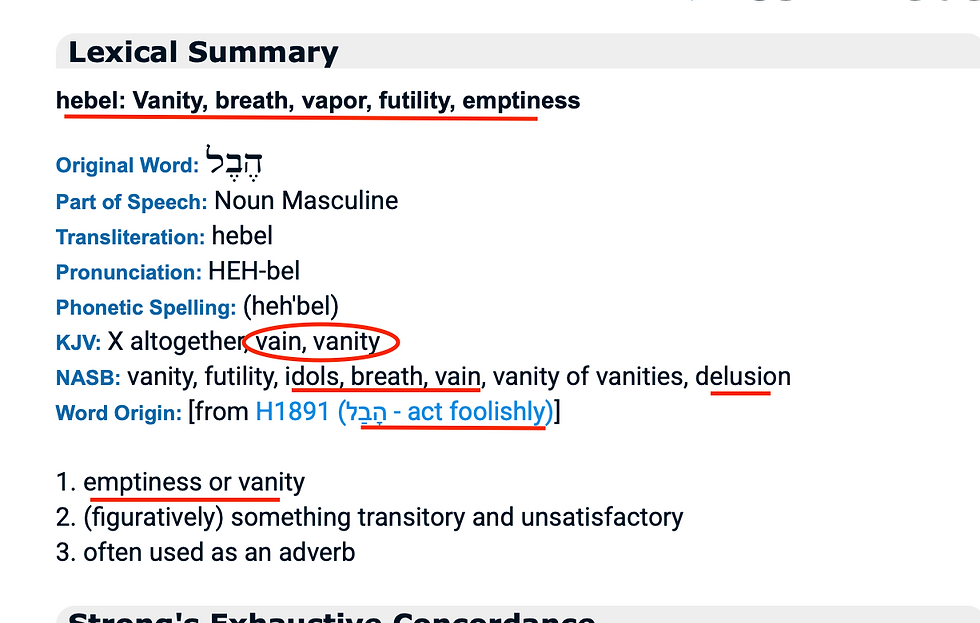
Modern day definition of "Vanity"
The word "vanity" is defined as "inflated pride in oneself or one's appearance..."
Or "vanity" is used to describe "something that is done with the aim of getting praise, fame, or approval -- rather than for serious or good reasons."
Example: think about Hollywood celebrities, who desperately fight to gain attention -- using their appearance, dressing provacatively, using their status or money to gain praise and fame...etc...
Or when politicians or elites arrogantly state that they have done "ABC" to help "(Fill in the blank)..." when in reality, those who boast about this stuff or what they've done to "help" the world, are only saying this to gain praise, attention, fame, likability. Most of these people don't speak or act with integrity or ethics, nor do they care to...
Rarely do we ever see this done authentically or genuinely, for good reasons... rather, it's usually done to promote a false image of themselves while enhancing their own self-image and self-pride.
The phrase "nothing new under the sun" comes from Ecclesiates 1:9.
Lacking inner love
People who lack inner love for themselves, and who do not value who they are, seek outside validation and at times may take extreme measures to find ways to fill their inner lack of self love & self-worth... does that make sense? These people don't care about anyone, because they barely care about themselves...They don't know how to love anyone - they do not love themselves.
A person who truly loves and values themself, doesn't seek outside praise or attention - it's unnecessary and beneficial to no one. A person who loves themselves will look internally for the love or praise they seek... rather than seeking it externally and basing it off of materialism...things which are void, substanceless, and ultimately don't matter at the end of the day.
"For in much wisom is much grief: and he that increaseth knowledge increaseth sorrow." Ecclesiastes 1:18.

"Vanity of Vanity & Vexation of Spirit"
The term "vanity" has some relation to this phrase "vexation of spirit" (read below)...
"I have seen the works done under the sun and behold, all is vanity and vexation of spirit..." Ecclesiates 1:14.
When I looked into the meaning of "vexation of spirit"...it defines it to mean: "feeding on wind..."
Additionally, the term "vexation" can be used when describing grief or anger.
Now, the term "wind" in Hebrew, is the word, "Ruach" - which means "spirit." So, I find it interesting that this "vexation of spirit" this "vanity of vanity" could very literally mean that "all is meaningless, feeding on spirit." (See below).

Consider the phrase:
"All is vanity and vexation of spirit..." - (Eccleasiates 1:14).
If the word "Vanity" was originally the Hebrew word "Habel" - (meaning breath or vapor) - we could further hypothesize that the terms: "vanity; breath; & vapor," are also synonomous to the word "wind" (as it is used within this context)? Are they interchangable terms? Allow me to clarify...
Notice that the phrase, "Vexation of spirit" is defined (in my bible - pictured above) as "feeding on wind" or "delighting on wind..." Interestingly, the word used to translate "wind" -- is the Hebrew word "Ruach." Ruach means "spirit," "breath," (see pic below).
So, it seems that these terms "wind, breath, spirit, vapor" -- are ALL referring to the same idea/concept -- the Ruach or spirit...(see picture below).

So, using the Hebrew understanding of the term "Vanity" & "Vexation of spirit," could we translate this verse to read: "All is vapor, illusion, breath, air...being fed on...?"
Or - perhaps: "All is illusion, feeding on spirit...?"
However, side note: the Hebrew word for SOUL, is "Nephesh," this is a different term from the words "spirit or "ruach." So, the Hebrew religion or language defines the spirit and the soul as 2 separate and distinct concepts...right? The spirit being "Ruach," and the soul being "Nephesh."
Other uses of the word "Vanity" in Scripture:
Jeremiah & Book of Job use the term in the meaning of lacking substance...
The Hebrew word "HAVEL" is used for the term "Vanity" in Jeremiah 2:5 -- in the context of describing something that is void or empty...and we see the Hebrew word "HACAL" used in the Book of Job 27:12, in the context that one should not speak vainly (or lacking substance).


THE WISE MAN DIES A FOOL
Ecclesiates 2:15-16

For there is no more remembrance of the wise more than of the fool for ever, seeing that which now is in the days to come shall all be forgotten. And how dieth the wise man? As the fool. (Ecclesiastes 2:16).

All is vanity

Therefore I hated life; because the work that is wrought under the sun is grievous unto me: for all is vanity and vexation of spirit.
Thanks for reading. Positivity to you all.
--FG


Comments